American Roulette
★ 4.6/5
RTP: 94.74% 
Every probability and payout in this guide was cross-checked against the certifying lab's published math for both single-zero (European) and double-zero (American) wheels. Where they differ, both numbers are listed.
Roulette has roughly two dozen distinct bets, each with its own probability, payout, and tactical use case. This guide walks you through every category — inside bets on the number grid, outside bets on the column margins, and the announced bets that originated in 18th-century French casinos — so you can pick the right wager for the variance you're after.
This guide is split into three sections. First, the main bets: inside and outside wagers placed on the standard betting layout. Second, the announced bets (sometimes called 'call bets' or 'French bets'): four named wagers that cover specific segments of the wheel itself. Third, exotic combinations like Snake, Finals en plein, and Finals a cheval — patterns that aren't formally codified but show up at most online tables as preset 'favourite' bets.
Every bet's win probability across both wheel types.
Straight up, split, street, corner, line — all six in detail.
Red/black, odd/even, high/low, columns, dozens.
How payouts are calculated, including for announced bets.
Plug in stake + bet type, see the expected payout.
Roulette bets fall into two main camps based on where you place the chip. Inside bets go on the numbered grid itself — they pay more but hit rarely. Outside bets sit along the table's edge — lower payouts, but they hit on roughly half of all spins.
Inside bets cover one to six numbers each. The straight-up bet on a single number pays 35:1 but hits only 2.7% of the time on European. As you cover more numbers (split, street, corner, line), the payout drops and the probability rises proportionally — the expected value stays the same across all inside bets at a given wheel.
Outside bets work differently. Red/black, odd/even, and high/low cover 18 of the 37 (or 38) pockets — almost half the wheel. They pay 1:1 and hit 48.65% of the time on European. Columns and dozens cover 12 numbers each, pay 2:1, and hit 32.43%. Outside bets don't include the zero, which is why their probability isn't a perfect 50% even though they cover 'half' the table.
All standard bets, with probabilities on both wheel types. American probabilities are lower because of the second zero.
| Bet | Category | Numbers covered | Payout | Probability (European) | Probability (American) |
|---|---|---|---|---|---|
| Straight up (single number) | Inside | 1 | 35:1 | 2.70% | 2.60% |
| Split (two adjacent) | Inside | 2 | 17:1 | 5.40% | 5.30% |
| Street (three in a row) | Inside | 3 | 11:1 | 8.10% | 7.90% |
| Corner (four in a square) | Inside | 4 | 8:1 | 10.80% | 10.50% |
| Basket (5-number) | Inside | 5 | 6:1 | — | 13.15% |
| Line / Six-line | Inside | 6 | 5:1 | 16.20% | 15.80% |
| Column | Outside | 12 | 2:1 | 32.40% | 31.60% |
| Dozen | Outside | 12 | 2:1 | 32.40% | 31.60% |
| Even / Odd | Outside | 18 | 1:1 | 48.60% | 47.40% |
| Red / Black | Outside | 18 | 1:1 | 48.60% | 47.40% |
| Low (1-18) / High (19-36) | Outside | 18 | 1:1 | 48.60% | 47.40% |
A note on combinations: some bets allow multiple placement options. The Three-numbers bet can include zero in patterns like 0-1-2, 0-2-3, or 0-00-2 on American — players call these Trio bets. Similarly, on European you can combine four numbers from 0 through 3 in non-standard layouts. These variants don't change the payout but expand the tactical palette.
Beyond the standard layout, roulette offers a second class of wagers called announced bets — sometimes called 'call bets' or 'French bets'. The name comes from the original 18th-century practice of verbally announcing the bet to the croupier rather than placing chips on the layout (the bets cover wheel segments, not table segments, so the layout can't represent them visually).
Today these bets are placed on a separate 'racetrack' interface that mirrors the physical wheel. There are four named announced bets, each covering a different segment of the wheel head.
9 chips covering 17 numbers around the green pocket — from 22 clockwise to 25 counter-clockwise. The biggest of the call bets.
4 chips covering 7 numbers nearest zero. A tighter version of Voisins — smaller stake, smaller coverage.
6 chips covering 12 numbers opposite zero. Roughly one-third of the wheel; popular for fading the zero pocket.
5 chips covering 8 numbers in the two arc segments NOT covered by Voisins or Tiers. 'Orphans' because they're left over.
Beyond the four canonical announced bets, you can place a Neighbour bet: pick any number on the wheel, the croupier covers it plus two to nine adjacent pockets (your choice) for a total of up to 19 numbers in a single arc. Place a chip on 9 and choose '2 neighbours each side' → you cover 9 plus two numbers clockwise and two counter-clockwise on the wheel head, for five pockets total.
Most online roulette platforms surface a few named preset combinations beyond the standard bets. These aren't part of the official rules, but they're widely available as 'favourite' or 'special' bets at the click of a button.
| Name | What it covers | Notes |
|---|---|---|
| Snake bet | 12 numbers forming a zig-zag pattern (1, 5, 9, 12, 14, 16, 19, 23, 27, 30, 32, 34) — all red. | Pays 2:1 like a column or dozen. Equivalent to betting 'red, but only these 12 reds'. |
| Finals en plein | All numbers ending in the chosen digit. e.g. Finals 3 = 3, 13, 23, 33 (4 chips). | Choose any digit 0-9. Numbers 0-6 give 4 chips; 7-9 give 3 chips. |
| Finals a cheval (Final Split) | Pairs of numbers ending in the chosen two digits. e.g. Finals 3-5 = 3-5, 13-15, 23-25. | Always 3 chips on European; expensive but well-distributed across the wheel. |
Real-money roulette is great for its wide choice of bet types: there are high-risk options with a win chance of just 2.63–2.7% but a 35:1 payout, while those who prefer a bird in the hand can place bets paying 1:1 at a 48.65% chance (and combinations let you raise the win chance even further). What to bet on is up to each player, and to weigh the available choices better we offer a detailed look at the main bet types with illustrative tables, clear examples and tips.
Important for beginners to grasp: different bet types don’t affect the game’s overall RTP, because online roulette works on a balance-of-extremes principle — either more frequent small wins, or rare big ones, or something in between. So there’s no single “most correct” bet.
This bet type suits those willing to win relatively rarely but with big payouts. Inside bets are bets on individual numbers or groups of them — no more than six numbers. At comparatively low odds of success on a single spin (2.7–16.2%), a win means a payout 5–35 times the stake.
| Bet type | Numbers | Payout | Chance (Eur.) | Chance (Am.) | Note |
|---|---|---|---|---|---|
| Straight Up | 1 | 35:1 | 2.7% | 2.63% | Maximum payout, minimum chance |
| Split | 2 | 17:1 | 5.4% | 5.3% | On adjacent numbers |
| Street | 3 | 11:1 | 8.1% | 7.9% | Horizontal (sometimes vertical) row |
| Corner | 4 | 8:1 | 10.8% | 10.5% | Corner of 4 numbers |
| Basket | 5 | 6:1 | — | 13.15% | American roulette only |
| Six Line | 6 | 5:1 | 16.2% | 15.8% | 2 rows in a row |
High-risk bets assume your bankroll has a margin of safety and you’re mentally ready for long losing streaks.
Outside bets offer the opposite approach (versus inside bets): win odds per spin are high here (at least 31.6%), but the payout equals the stake or “merely” doubles it. Such bets cover a significant part of the wheel.
| Bet type | Numbers | Payout | Chance (Eur.) | Chance (Am.) | Note |
|---|---|---|---|---|---|
| Column | 12 | 2:1 | 32.4% | 31.6% | Vertical column |
| Dozen | 12 | 2:1 | 32.4% | 31.6% | 1st, 2nd or 3rd dozen |
| Even/Odd | 18 | 1:1 | 48.6% | 47.4% | Excludes zero |
| Red/Black | 18 | 1:1 | 48.6% | 47.4% | Excludes zero |
| Low/High | 18 | 1:1 | 48.6% | 47.4% | 1–18 / 19–36 |
Outside bets in online casinos appeal to those who like a cautious roulette strategy with small but regular top-ups to the bank.
This is a unique bet offered only by American roulette. The Basket covers five numbers: two zeros, 1, 2 and 3, and this is the least favourable bet in all roulette variants. The win chance is 13.15%, but houses pay only six-fold for success: with that math the long-run RTP is 92.11%, whereas for other American-roulette bets the figure is 94.74%, for European 97.3%, and for French (for 1:1 bets) a full 98.65%.

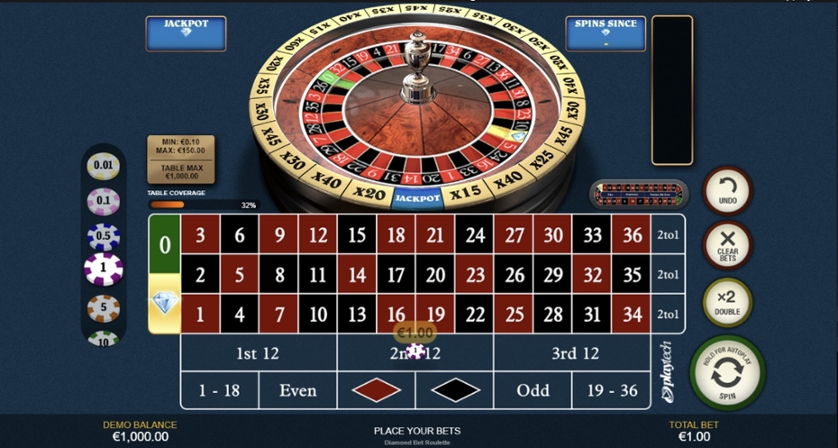
On a first visit to an online casino a newcomer may be confused about how to place a bet, but there’s really nothing complex about it. Live-dealer roulette and RNG versions offer the same placement principle — let’s go step by step.
The panel at the bottom of the roulette interface sets the chip value. Available chip denominations differ by table, but many providers accept bets under $1, while at high-roller tables a single chip can cost a three-digit dollar sum. We recommend starting your acquaintance with the game at small stakes. If needed, you can spend several chips on one bet.
Roulette uses one click to place one chip; if you’re betting several chips, click the same spot several times:
The interface highlights the potential bet at the current cursor position — a very useful hint.
Until the roulette is spun again, a player may place two or more bets on the upcoming spin. Say you can put five chips on black and one more specifically on number 14, spending six chips in total. Here the bets don’t overlap (both can’t hit at once), but if one hits, you get its due payout. A partial overlap of bets (e.g. on red overall and on one specific red number) leaves a chance for several bets to hit at once.
In live roulette a player has roughly 30–45 seconds between spins to decide on a bet, whereas the RNG is ready to wait forever. Having decided and placed your chips, confirm with the button that the decision is final (if you misclicked, the bet can be changed before confirmation). Now wait for the spin to finish, and if the bet hits, the payout is credited automatically.
Many roulette interfaces have a “Repeat bet” (Re-Bet) button: press it and in one click you place everything you placed on the previous spin. Often there are also special buttons to double the bet on the same numbers (Double) or clear wrongly placed bets (Clear).
Inside bets are so called because they’re placed inside the number grid — one bet on between one and six numbers. Inside bets keep roulette’s general pattern: the fewer numbers a bet covers, the lower the win chance and the higher the potential payout.
A straight-up bet is an attempt to guess the exact number the ball will stop on, and any alternative result means a loss. European and French roulette leave just a 2.7% chance of success (1/37); in the American version the “extra” zero further reduces the odds — to 2.63% (1/38). But a win will dramatically affect both the player’s pulse and the bank: if you guess right, you get a 35:1 payout — stake $5 and you take back both the stake and the $175 you won! Straight-up bets only make sense with a large bankroll and angelic patience, because on average wins happen only once in 37 spins.
A straight-up bet covers only one number, but there’s nothing wrong with making several straight-up bets on any numbers you like. If you bet on, say, 6 numbers, such a bet resembles a six line, but unlike a six line you choose which numbers to bet on yourself — they can even be scattered. As for value, both bets are identical: if they hit, you come out five-fold ahead (because with six straight-up bets five chips are guaranteed lost).
A split is a bet on two numbers placed side by side (in any configuration) on the betting field, and you can fund this prediction with even one chip. The win chance doubles versus a straight-up bet — to 5.4% — and the payout equals 17:1 (stake $5 and you collect the stake plus a $85 win). For many players this looks like the optimal balance of risk and reward.
This is a bet on three numbers — either a row, or zero and two numbers from the adjacent row (the latter, a so-called trio, is available only in European and French roulette, not American). The win chance rises to 8.1%; on a win the payout is 11 times the stake.
This bet covers four numbers arranged at the corners around the placed chip, giving a 10.8% win chance. On success the casino pays 8× your bet plus returns the stake. The European version of roulette offers a special corner option: 0-1-2-3, a bet usually absent in alternative versions of the game.
A bet on six numbers at once — two adjacent rows (in some interface variants, two columns) on the betting field. A six line hits with a 16.2% chance, the maximum wheel coverage among inside bets. A win provides the stake back plus a five-fold win. This bet is popular among players on a small budget — it wins comparatively often, minimising the chance of long losing streaks and losing the whole bank.
Outside bets can be used by experienced players too, but for a roulette newcomer they’re especially useful: there won’t be big wins, but there aren’t overly frequent losses either, which helps preserve the bank. Most roulette strategies build on outside bets.
The most popular option in roulette is even-money bets — the payout is 1 to 1, and the win chance in the European version is 48.65%. So losses still happen slightly more often because the player also loses when zero comes up — which is why a profit over a long enough run is impossible. The value of even-money bets lies in the simplicity of the rules, frequent if small wins (very useful for a small bankroll), and the chance to use numerous strategies with this approach.
A fact that’s not obvious to some beginners: although red/black and even/odd bets belong to one type (even money — 1 to 1 payout), they don’t complement each other but partly overlap. If you bet on black and odd at once, you cover not 36 numbers but only 27, with 9 of them covered twice. On one hand that’s a chance for both bets to hit; on the other you can lose both — important to understand if you plan to combine.
Columns are vertical (in some interface variants horizontal) rows of 12 numbers (e.g. 1, 4, 7, 10, 13, 16, 19, 22, 25, 28, 31, 34), whereas dozens are groups of 12 numbers but in order (1–12, 13–24, 25–36). The win chance of such a bet is 32.4% in the European version, and the payout is twice the stake (plus the stake back).
Covering nearly ⅔ of the wheel and raising the win chance to the same level is possible by betting two of three dozens or two of three columns. If one such bet hits, the player comes out ahead (bet one chip each on two columns — lose one, the second returns with two more chips of winnings), but on average every third spin will lose for both bets. Betting a column and a dozen at once works the same as betting on colour and even/odd: this doesn’t cover twice as many numbers, but some numbers will be covered twice.
Announced bets are an option available on a special field — the racetrack — most typical of French roulette. Such bets are also called sector bets — they cover sectors of the wheel, given that the numbers are placed on it in scattered order. You can’t put a single chip on a sector bet — they have a fixed “cost” in chips.
This bet is taken on the numbers around zero — from 17 to 25 (17 in total). The cost of such a bet equals 9 chips:
In essence this is a combination of several bets, and the payout depends on which one hits:
The variety of possible results makes this bet especially interesting, and the chance of some win is a solid 45.9%.
This sector covers exactly a third of the wheel if you don’t count zero, and the 12 numbers included in Tiers du Cylindre (from 27 to 33 inclusive) sit opposite zero. Such a bet costs 6 chips: essentially, six splits. The win chance of this bet in European roulette is 32.4%, like a dozen or column, and the payout on a winning split is 17:1; on a win we lose the five chips on losing splits, but even so come out +12 units.
The numbers not included in the two sectors above are called Orphelins; you can bet on them too, spending 5 chips: place four splits (number 17 goes into two splits at once) and make a straight-up bet on number 1. Eight numbers is a 21.6% win chance, and the size of the potential payout depends on where the ball stops:
Like “neighbours of zero”, this bet is interesting for the variety of wins, but the chip count is more modest and the risk higher.
This is a reduced version of the Voisins du Zéro bet: here too is zero itself, and around it the numbers from 12 to 15. The bet costs 4 chips: one each on three splits and a straight-up bet on number 26. The win chance is 18.9%, and payouts equal 17 to 1 if a split hits (the player is +14 chips), or 35 to 1 if the straight-up on number 26 wins (huge luck of +32 chips). This bet is often used without a racetrack too — casino patrons can place three splits and a straight-up bet by hand.
For greater clarity on sector bets, here’s a table.
| Bet type | Numbers covered | Chips | Payout | Numbers |
|---|---|---|---|---|
| Voisins du Zéro | 17 | 9 | 17:1 (split) 11:1 (trio) 8:1 (corner) | 22, 18, 29, 7, 28, 12, 35, 3, 26, 0, 32, 15, 19, 4, 21, 2, 25 |
| Tiers du Cylindre | 12 | 6 | 17:1 (split) | 5, 8, 10, 11, 13, 16, 23, 24, 27, 30, 33, 36 |
| Orphelins | 8 | 5 | 35:1 (straight) 17:1 (split) | 1, 6, 9, 14, 17, 20, 31, 34 |
| Jeu Zéro | 7 | 4 | 35:1 (straight) 17:1 (split) | 12, 35, 3, 26, 0, 32, 15 |
To a beginner the concept of sector bets may seem complex, but with experience you’ll surely come to appreciate them.
If a player believes in the “hot number” concept but allows small deviations in results (and with a worn physical wheel in live roulette this can make sense), bet on a specific number and a certain number of its neighbours. All such bets are straight-up; the stated number of neighbours means you bet that many on each side: e.g. number 7 with two neighbours is actually five numbers. The player chooses the central number and its neighbour count (from one to four): the more bets, the higher the win odds, but the larger the loss on a miss.
There are specific chip-placement patterns that don’t need a racetrack and interest experienced roulette players.
The Snake is a visually pretty bet: with a zigzag of chips the player crosses the whole number field, making straight-up bets on numbers 1, 5, 9, 12, 14, 16, 19, 23, 27, 30, 32, 34. In meaning it’s much like a dozen or column: 12 numbers covered, win chance 32.4%, and on success the payout is effectively 2:1 (11 chips lost, the twelfth returns with a 35-to-1 win) — the player is +24 chips if they bet one everywhere.
Another “pretty” combination of straight-up bets — on all numbers ending in the same digit. Accordingly, the combination can contain either four numbers (e.g. 2, 12, 22, 32) or three (8, 18, 28 — there’s no 38 on the wheel).
The player will have a clearer understanding of how Finals en Plein work thanks to the table.
| Last digit | Numbers | Chips needed | Win chance | Payout on a hit |
|---|---|---|---|---|
| 0 | 0, 10, 20, 30 | 4 | 10.8% | 35:1 |
| 1 | 1, 11, 21, 31 | 4 | 10.8% | 35:1 |
| 2 | 2, 12, 22, 32 | 4 | 10.8% | 35:1 |
| 3 | 3, 13, 23, 33 | 4 | 10.8% | 35:1 |
| 4 | 4, 14, 24, 34 | 4 | 10.8% | 35:1 |
| 5 | 5, 15, 25, 35 | 4 | 10.8% | 35:1 |
| 6 | 6, 16, 26, 36 | 4 | 10.8% | 35:1 |
| 7 | 7, 17, 27 | 3 | 8.1% | 35:1 |
| 8 | 8, 18, 28 | 3 | 8.1% | 35:1 |
| 9 | 9, 19, 29 | 3 | 8.1% | 35:1 |
The value of such a bet depends directly on whether 3 or 4 numbers entered the combination: in the first case the plus is +33 chips, in the second +32.
In meaning this is much like Finals en Plein, only we choose not one last digit but two, and bet splits on them; e.g. if the last digits are 2 and 7, our splits are 2-7, 12-17, 22-27. Depending on the chosen last digits, such a bet needs 3 or 4 chips; accordingly, the win chance in European roulette is 16.2% or 21.6%, and the payout on a win is 17:1 (+14–15 chips).
The bets covered in this article are mostly appropriate for all roulette variants, but the three big varieties of the game stand out for a reason — each has specific features.
This version is considered classic; most bets are available in it, and the average RTP is 97.3%. A racetrack is more often absent, which can complicate placing announced and combination bets that can only be made by hand. There are modifications of European roulette that add the En Prison rule.
It differs primarily in having two zeros, which is why the RTP drops to 94.74%, and the win chance of any bet falls somewhat because of the extra cell (e.g. red/black — 47.37% win chance, not 48.65%). The second zero introduces the special Basket bet (0, 00, 1, 2, 3), not offered in alternative roulette variants, but because of its relatively low 6:1 payout its RTP is only 92.1% — i.e. it’s unfavourable. A racetrack is absent, and French bets aren’t accepted.
Visually the French roulette wheel looks like an exact copy of the European one (plus a mandatory racetrack), but on even-money bets, when zero comes up, the La Partage (half the stake returned) and En Prison (another spin for the same money) rules apply. Thanks to this modification the RTP of 1:1 bets rises to 98.65%, though for all the others the “European” 97.3% remains.
Although over the long run all roulette bets keep some house edge, the favourability of different bets in different versions varies.
| Bet type | European | American | French |
|---|---|---|---|
| Straight Up | 97.30% | 94.74% | 97.30% |
| Red/Black | 97.30% | 94.74% | 98.65% |
| Even/Odd | 97.30% | 94.74% | 98.65% |
| Dozen/Column | 97.30% | 94.74% | 97.30% |
| Basket (5 numbers) | unavailable | 92.10% | unavailable |
For even-money bets (1:1 payout) French roulette is the best choice — the La Partage and En Prison rules deliver the maximum RTP.
For most visitors roulette is their first casino experience, because everyone has seen it in films and everyone finds it interesting. But if you want to avoid disappointment and appreciate the game right away, it’s important to understand where to begin.
You can choose a different order of steps, but we recommend playing like this:
Remember: the ability to play roulette is very conditional, since wins on individual spins depend on luck, and over the long run on math. Roulette is available free in demo mode — that lets you try every approach to the game without material risk.
There are no guaranteed wins in roulette, so be mentally ready to lose the whole bankroll. To keep that from happening too fast, bet no more than 1–2% of the bank at a time: if you don’t chase only high-risk bets, the bankroll will top up with wins from time to time, so it can be stretched over a long session.
There are bets that newcomers to roulette are better off avoiding:
Follow the sequence of steps above — that way you’ll gradually figure out the rules and get drawn into the game.
Published Updated