
American Roulette
★ 4.6/5
RTP: 94.74% 
To an untrained eye all roulette games look alike — but they differ in many ways, one of which is the design of the wheel and table. Here we explain the components, the variant differences in pocket count and order, and the manufacturers that build the precision wheels casinos rely on.
The roulette wheel is the heart of the game. It contains alternating red and black numbered pockets, plus the additional green 0 (European/French) or 0 and 00 (American) pockets. Its construction guarantees randomness on every spin. Players bet on where the ball will land; the wheel's rotation determines the outcome. Understanding these components is essential for understanding the game's dynamics.
The decorative dome at the very centre of the wheel head. It holds the spindle in place and is usually machined from polished brass or chromed steel — both for looks and to add a touch of weight at the rotor centre.
The vertical axle the wheel head rotates around. Mounted on precision ball bearings so the rotor can spin for 60–90 seconds on a single push from the croupier with almost no friction loss.
The free-spinning disc that carries the numbered pockets. Sits on the spindle and is launched in one direction; the croupier sends the ball spinning in the opposite direction along the ball track.
The annular ring on the wheel head that holds the numbered slots. European wheels carry 37 pockets (0–36); American wheels add a second 00 pocket for a total of 38. The numbering sequence is non-consecutive to spread risk.
The individual numbered slots cut into the pocket ring. Each is sized just slightly larger than the ball so it can settle cleanly. Half the non-zero pockets are red, half are black; the zero (and double zero) are green.
The cushioned bottom inside each pocket. Made of soft synthetic material to absorb the ball's energy and prevent it from bouncing back out once it settles. Casinos replace worn pads regularly to keep landings consistent.
The thin metal walls between adjacent pockets. They guide the ball into a pocket once it loses momentum. Modern "low-profile" frets are deliberately shorter than older designs, making the wheel less predictable.
The outer wooden ring the ball spins along after the croupier launches it. Polished and slightly sloped inward — gravity does the rest as the ball loses energy and begins drifting toward the centre.
A small sphere, typically 18–21 mm in diameter, traditionally made from ivory but today from acetal or Teflon. Light enough to bounce dramatically off frets and deflectors before settling.
The eight raised diamond-shaped pegs (sometimes called "canoes") on the inner slope between the ball track and the pocket ring. They scatter the ball's trajectory and add an extra layer of randomness to where it lands.
The sloped wooden section connecting the ball track to the pocket ring. Once the ball loses enough velocity to fall off the track, it slides down the apron, sometimes ricocheting off a deflector along the way.
The wooden housing that contains the entire wheel — typically crafted from mahogany, walnut, or rosewood for premium tables. Provides structural rigidity and absorbs vibration during play.
The painted ring on top of the pocket ring showing the visible numbers. Reading the European sequence clockwise from 0: 32, 15, 19, 4, 21, 2, 25, 17, 34, 6, 27, 13, 36, 11, 30, 8, 23, 10, 5, 24, 16, 33, 1, 20, 14, 31, 9, 22, 18, 29, 7, 28, 12, 35, 3, 26.
The pedestal the wheel sits on. Heavy and bolted to the table to prevent any vibration during play — even a small tilt would bias the ball over thousands of spins.
Tip — click any numbered point on the wheel to read what it does. Use ← / → to step through.
European, American, French, and Triple Zero variants differ in the number of zero pockets and the total pocket count. These differences affect RTP and house edge. They also differ in pocket ORDER on the wheel head, and in how outside bets are labelled and positioned on the table layout.
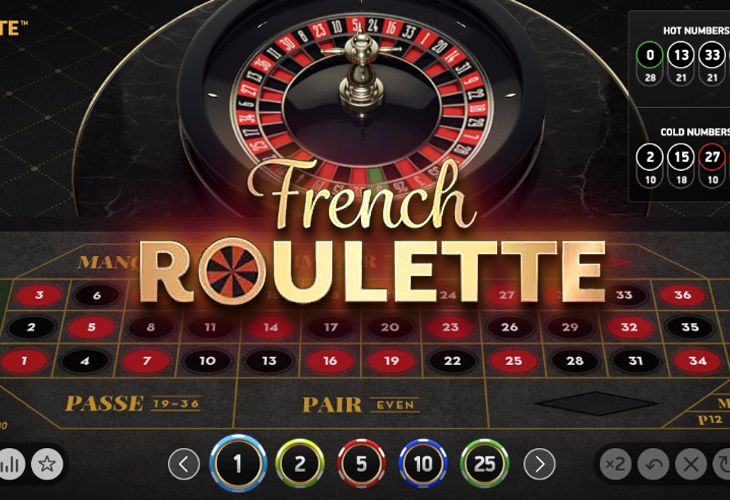
Table design itself doesn't vary dramatically between variants — but it's worth noting that on French roulette the outside bets are labelled in French and may sit in different positions on the layout. In this variant the outside bet names are: Manque (Low, 1-18), Passe (High, 19-36), Impair (Odd), Pair (Even), P12 Premiere Douzaine (first dozen), M12 Moyenne Douzaine (middle dozen), D12 Dernière Douzaine (last dozen).
The order of numbers around the wheel head, starting from 0 and walking clockwise. American differs significantly because of the 00 pocket; the others share more structure.
| Variant | Zeros | Sequence | Total |
|---|---|---|---|
| European | 1 | 0, 32, 15, 19, 4, 21, 2, 25, 17, 34, 6, 27, 13, 36, 11, 30, 8, 23, 10, 5, 24, 16, 33, 1, 20, 14, 31, 9, 22, 18, 29, 7, 28, 12, 35, 3, 26 | 37 |
| American | 2 | 0, 28, 9, 26, 30, 11, 7, 20, 32, 17, 5, 22, 34, 15, 3, 24, 36, 13, 1, 00, 27, 10, 25, 29, 12, 8, 19, 31, 18, 6, 21, 33, 16, 4, 23, 35, 14, 2 | 38 |
| French | 1 | 0, 32, 15, 19, 4, 21, 2, 25, 17, 34, 6, 27, 13, 36, 11, 30, 8, 23, 10, 5, 24, 16, 33, 1, 20, 14, 31, 9, 22, 18, 29, 7, 28, 12, 35, 3, 26 | 37 |
| Triple Zero | 3 | 0, 000, 00, 32, 15, 19, 4, 21, 2, 25, 17, 34, 6, 27, 13, 36, 11, 30, 8, 23, 10, 5, 24, 16, 33, 1, 20, 14, 31, 22, 18, 29, 7, 28, 12, 35, 3, 26 | 39 |
The pocket order is deliberately non-consecutive — adjacent numbers on the betting layout (like 1 and 2) sit far apart on the wheel head. This randomises risk across the wheel and prevents 'sector betting' exploits from biased-wheel detection. The European and French sequences are identical; American re-orders everything to accommodate the 00 pocket; Triple Zero adds 000 to the European pattern.
Wheels and tables at land-based casinos are manufactured by specialist companies. Casinos must work with reputable, well-established brands — it's the only way to get unbiased wheels with no physical defects. Roulette wheels must be perfectly level and regularly replaced. As of 2026, the most reputable manufacturers are Cammegh, TCS John Huxley, and Abbiati.
The companies that supply 95% of premium casino-grade wheels.
On the market since 1989
On the market since 1973
On the market since 1976
Cammegh was founded by Bill Cammegh in 1989. UK-based; supplies wheels to almost every casino in Europe and Australia. Offers three lines: manual, mini-manual, and automatic. Uses wood and carbon fibre in construction. Three GA (Gambling Awards) winner.
TCS John Huxley has been producing casino equipment for almost 50 years and is the most recognised brand for custom wheel design. Markets their wheels under the 'Saturn' name; offers a 'Glo' line with illuminated frets for nighttime visibility.
Abbiati, founded in 1976, is one of Italy's largest casino equipment makers. CQY-certified (Certified Quality System) and a member of the European Casino Association (ECA). Builds wheels only for American and European variants; uses microfibre and wool in table construction.
To many newcomers, online roulette looks fairly simple — but in reality there are three main variants and a countless number of additional ones, each with different rules and therefore different gameplay concepts. In this article we look at how the roulette wheel and table are built, so the reader understands how to choose a variant and what it affects.
A physical roulette wheel, even in an online casino, must be perfectly balanced — otherwise the equal probability of every number landing breaks down. For that reason a quality wheel costs no less than $10,000, and every part of it matters. Let’s split the parts into groups for an easier look.
Let’s start with the top of the wheel — the rotor, i.e. the part that actually spins:
Perfect balance of the wheel’s top makes the game fair; the slightest deviation gives the wheel “hot” numbers. Modern technology lets the top be balanced perfectly — a laser level is used for that.
A ball launched onto a freshly spun wheel can hop from one pocket to another due to the wheel’s rotation, but at a certain point the spinning force runs out and the ball settles on the number that will win. The ball’s ability to “jump out” depends directly on pocket depth, and the deeper they are, the earlier a professional player can tell which number will win — which lets them draw conclusions sooner and gain more time to think over their next moves.
Although the ball settles in a pocket, most of its movement involves other parts of the wheel:
The guides make the ball’s trajectory even less predictable, which is what makes gameplay so interesting. With experience, players gain the ability to predict where on a particular wheel the ball tends to deflect more often, which is why the design allows the deflector positions to be changed.
Although only the wheel spins, the stationary base is also critically important:
The base’s job is overall stabilisation, so that while the rotor spins it stays steady and doesn’t vibrate. Bearings wear out roughly every 3–5 years — when they fail, the whole wheel must be replaced, because its balance is irreversibly compromised.
Experienced players have a keen eye: if a real-money wheel develops even the slightest tilt, producing “hot” numbers, the venue risks going deep into the red. Casinos try to avoid this by every means:
Such measures all but eliminate the detection of “hot” numbers by players.
At first glance it may seem there’s no logic at all to the number arrangement, but in fact it’s quite the opposite: the “chaotic” placement of numbers is an additional balancing factor for the odds.
The number layout on the identical European and French wheels took shape back when wheels often weren’t perfectly balanced, and the apparent lack of order is actually meant to further minimise the chance of statistical anomalies favouring “hot” numbers. Broadly, the placement logic is this:
Even if a wheel has tilted badly and wins keep landing in a particular sector, players still have to guess.
The cardinal difference of the American wheel is the addition of another zero — 00. The extra number somewhat upsets the balance worked out for European roulette, so the creators of the American wheel fundamentally changed the order of numbers, though all the principles described above are preserved, and the two zeros were placed opposite each other. When placing sector bets (Voisins, Tiers, Orphelins) on American roulette by hand, the player must understand that the set of straight-ups, splits, trios and corners will differ from what they’re used to on European roulette.
A relatively rare variety is the three-zero wheel, which appeared in 2016. Its popularity is pushed in Las Vegas, aimed at inexperienced land-based casino visitors; on the other hand, the RTP is only 92.3%, against which even ordinary American roulette looks tempting. The number sequence here is broadly identical to European, while the three zeros are grouped together as 0-000-00.
To visualise the differences between the wheels, here’s a table with the main parameters.
| Variant | Zeros | Numbers | RTP | House edge | La Partage | Racetrack |
|---|---|---|---|---|---|---|
| European | 1 | 37 | 97.30% | 2.70% | No | Often yes |
| American | 2 | 38 | 94.74% | 5.26% | No (Surrender) | No |
| French | 1 | 37 | 97.30% / 98.65% | 2.70% / 1.35% | Yes | Yes |
| Triple Zero | 3 | 39 | ~92.3% | ~7.7% | No | No |
In terms of wheel construction, French roulette is completely identical to European.
The roulette wheel is often divided into three sectors of different size, so an entire sector can be covered by a single sector bet. When a racetrack is present (typical of French rules, and European roulette often features one too), a sector bet can be made in one click if you’re playing online, or simply by calling out the sector name to the croupier at a land-based venue. But sector bets can also be made without a racetrack — they’re all sets of “ordinary” bets you can memorise. Let’s look at the sectors using European roulette as the example, keeping in mind that the number order on the American wheel is different.
The largest sector, covering 17 numbers from 22 to 25 clockwise — 22, 18, 29, 7, 28, 12, 35, 3, 26, 0, 32, 15, 19, 4, 21, 2, 25. The Voisins sector bet “costs” 9 chips:
Even the minimum payout (on the corner) is 8 to 1, putting the player in profit; the chance of any win is almost 46%.
The neighbours of zero as a sector bet assume the player bets specifically on the numbers next to zero on the wheel itself. If you bet on the “neighbours” of zero based on their position on the table grid, on the wheel they’ll actually be scattered, with no sector coverage.
This sector covers exactly a third of the wheel (ignoring zero), positioned almost perfectly opposite zero — from 33 to 27. The bet consists of six splits of 1 chip each — on 5-8, 10-11, 13-16, 23-24, 27-30 and 33-36. With a 32.4% win chance, any success means a 17:1 payout, more than covering the cost. Many players cover both Voisins and Tiers at once: the win chance rises to 78%, and with a 15-chip bet even the minimum win (a corner in Voisins) still leaves the player in a small profit.
Orphelins are the remaining numbers not included in the sectors above, grouped into two clusters between them. Closing this sector too takes 5 chips: a straight-up on 1 and four splits (6-9, 14-17, 17-20, 31-34), with the number 17 being covered twice (if it lands, you collect the win on both splits — 34:2). Closing all three sectors is unprofitable: although Voisins, Tiers and Orphelins together mean a 97.3% win chance (always, except zero), their combined cost of 20 chips won’t be covered by most wins.
A simplified version of Voisins, covering only 7 numbers in the range from 12 to 15: this mini-sector is covered for 4 chips thanks to a straight-up on 26 and three splits on the remaining numbers.
So players don’t have to keep the components of sector bets in their heads, roulette’s creators invented the racetrack — a round betting field that mimics the wheel. When a racetrack is present — typical of French roulette and often found in European too — a sector bet can be made in one click, and bets on the neighbours of any number are accepted too. Leading providers including Evolution, Playtech and Pragmatic Play offer a racetrack in their RNG games, and live roulette supports it too.
The roulette table is a betting section (the layout), where the numbers run in the correct order, not the way they sit on the wheel. Once a player understands the table’s logic, they can make more considered bets without wasting time.
The numbers on the table from 1 to 36 are split into 12 rows of 3 numbers (1-2-3, 4-5-6 and so on) and 3 columns of 12 numbers (1, 4, 7 and so on). Zero (two zeros on American roulette) belongs to neither rows nor columns. You can bet on individual numbers or on the edges between them, covering several numbers with a single chip (split, street, corner, six-line).
Bets on large groups of numbers are called outside bets — they’re placed in dedicated fields outside the number grid. The outside bets are:
The last three are also called even-money bets: were it not for the zero factor, their win chance would be 50/50.
Roulette terminology is usually translated into your interface language or given in English, but on French roulette, an example of tradition, the bet names are never translated. These are the same bets as on European roulette, you just need to know the equivalents:
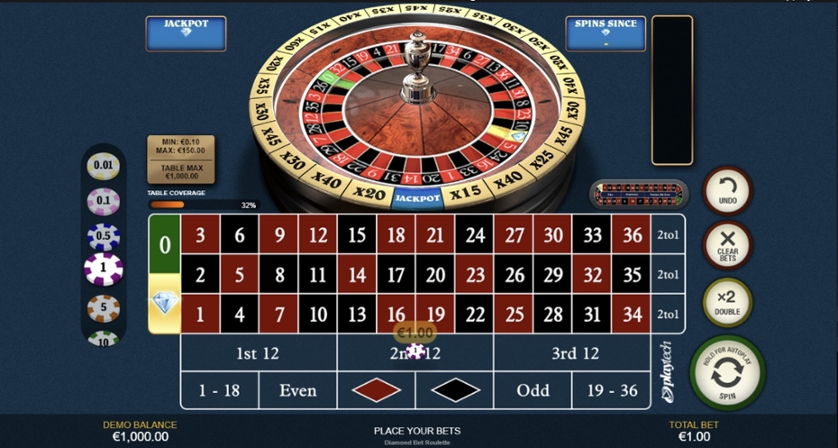
On physical tables there’s often no racetrack at all, and sector bets are called announced bets precisely because they’re called out aloud. Online it’s all different: some tables have no racetrack at all, and making a sector bet in one click is impossible; others display it permanently, like NetEnt and Playtech. Evolution Play takes a third route: the racetrack is there, but hidden by default — it appears after pressing a button which, in different games, may be called Racetrack, simply Track, or Special Bets.

We’ve already explained the obvious: the wheel can differ between roulette versions; now let’s look in detail at what the difference consists of.
The European wheel is the most widespread, although it could just as well be called French, since the two roulette variants use identical wheels. With 37 numbers (18 red and 18 black) and one green zero, the sequence is: 0-32-15-19-4-21-2-25-17-34-6-27-13-36-11-30-8-23-10-5-24-16-33-1-20-14-31-9-22-18-29-7-28-12-35-3-26. This standard is perfectly balanced and proven over several generations, and many roulettes with specific rules are built on top of it.
The two roulette versions have numerous differences — it just so happens that the wheel isn’t one of them. The other differences are easy to spot:
Identical wheels mean sector bets work the same way on European and French roulette.
Because of the two zeros (one opposite the other) the American wheel has 38 numbers, and the sequence was changed — here it looks like 0-28-9-26-30-11-7-20-32-17-5-22-34-15-3-24-36-13-1-00-27-10-25-29-12-8-19-31-18-6-21-33-16-4-23-35-14-2. An experienced player needs time to switch from sector bets on the European/French wheel to the equivalent bets on American roulette, because the “American” usually has no racetrack, and the combinations for manually covering Voisins or Tiers will be entirely different.
In essence, this is the European/French wheel, but with three zero pockets (0, 000, 00) as a single group. The new entertainment format appeared in 2016 in Las Vegas casinos, which automatically boosts its popularity. Players who are good at maths have already worked out that this format is unprofitable, since the house edge is around 7.7%, almost triple that of the European standard. Land-based venues lure customers to these tables with lower bet limits and the atmosphere of a “real” casino, but online this variety is barely present — it simply wouldn’t be chosen.
A casino can’t afford low-quality wheels — that would lead to the venue regularly losing or to complaints of unfair play. There are up to ten wheel manufacturers in the world, guaranteeing impressive durability and proper certification of their products.
A British company named after its founder Bill Cammegh, in business since 1989 and the main supplier for European and Australian land-based venues. Cammegh products are made from wood and carbon fibre in three main classes: full-size manual, mini manual, and automatic wheels. Cammegh’s signature wheels have repeatedly won industry awards as the best of their kind.
This Australian brand markets its wheels under the Saturn name — over the last fifty years they’ve been in demand in their native Australia and in Macau. Some models are fitted with illumination, which makes gameplay in low light especially mysterious.
Another company with half a century of history and a head office in Milan, producing wheels in both European and American standards. Abbiati products are CQY-certified, and the company also stands out for its wide choice of available materials: tables are covered in felt, microfibre, and even woollen fabrics.
It’s easier to get your bearings among the leading roulette wheel manufacturers with a table.
| Manufacturer | Year | Country | Specialisation | Key feature |
|---|---|---|---|---|
| Cammegh | 1989 | United Kingdom | Manual and automatic wheels | Carbon fibre, 3 GA awards |
| TCS John Huxley | ~1975 | Australia | Illuminated wheels | Saturn line, Glo option |
| Abbiati | 1976 | Italy | European and American wheels | CQY-certified, various upholstery |
If a land-based casino has chosen products from any of these three manufacturers, the visitor is sure to be satisfied.
This article is mostly about the physical design of roulette at land-based venues, while online live roulette uses the same mechanics — only the player is on the other side of the screen rather than at the table. RNG roulette has no wheel as such at all — there everything is decided by an algorithm.
Many online roulettes run on a random number generator (RNG) — that is, there’s no physical wheel; in front of you is an ordinary computer simulation program. Although a spinning wheel is shown in the interface, the result is actually determined by the algorithm instantly, and the visual element is only there “for show”. RNG algorithms undergo special certification — representatives of specialist bodies including eCOGRA, iTech Labs and GLI run them millions of times to make sure the consecutive results aren’t predictable. This is the only roulette available free and without registration — its production cost is low enough to let visitors play even without money, using demo mode.
Live roulette involves everything real: the wheel, the ball and the croupier, only the player takes part remotely — via video stream. Although the ball determines the winner, an automatic OCR system handles the distribution of winnings — a camera recognises the winning cell without human involvement, which is why it’s subject to special certification. The wheels for such roulette are supplied by the renowned manufacturers mentioned in this article — Cammegh and TCS John Huxley.
Launching a physical wheel with a stream for players is possible without a croupier too — wheel manufacturers learned to automate this process long ago. The benchmark of an automatic wheel is the Cammegh Slingshot model, beautiful and reliable. An automatic roulette has no chatter during the pauses, so the pace of play is faster (roughly up to 35 seconds per round), but both the physics and the house edge are equivalent to classic live roulette.
For players truly in love with roulette, its history is interesting too.
By one account, roulette (or rather its prototype) was invented by none other than the great French mathematician Blaise Pascal — long before casinos and gambling houses existed, while he was staying in… a monastery. The scientist supposedly demonstrated a spinning wheel with a ball in 1655, either as a prototype of a perpetual-motion machine or as a mathematical model describing the probability of one of 36 numbers landing. However, this assumption has no solid evidence: other researchers claim, for example, that a game resembling modern roulette actually came from Ancient China. It’s known that by the mid-18th century gambling was in wide demand, and in the territory later called Quebec it was already being banned — including something described in the document as roulette (though it’s not certain it was a game with rules resembling the modern ones). On the other hand, roulette resembling the modern game definitely existed in Paris by 1796 — albeit with 38 sectors, including two zeros: a red one and a black one.
Half a century later the zeros on roulette wheels had become green, but there were still two of them. The situation was changed by the brothers Louis and François Blanc — Frenchmen who left for German lands after roulette was banned in France in 1836. In 1842 they set about creating a whole network of gambling venues, and to win the competition they reduced the number of zeros to one, thereby improving the player’s chances of success. In 1860 these same brothers opened a casino in Monaco, where gambling had just been legalised while in France it remained outlawed — this finally cemented the 37-number wheel as the standard for European (and French) roulette. Roulette crossed the ocean via New Orleans, before the Blanc brothers’ innovation had truly caught on, which is why American roulette kept its two zeros.
Digital technology radically overturned the idea of gambling: as early as 1996 the first online casinos appeared, offering RNG roulette. Internet access was far from universal back then, and the graphics looked very modest, but seven years later, in 2003, the first live roulette with a real dealer appeared. A new trend was set in 2018 — Evolution Gaming launched Lightning Roulette, a version of the game with multipliers, which quickly became popular and spawned a wave of imitations. Since 2022 leading developers have been experimenting with VR roulette, but so far this format hasn’t achieved a stable interface or wide adoption.